
Black Hole
Diagram Science Apron Featuring a White Wireframe Black Hole
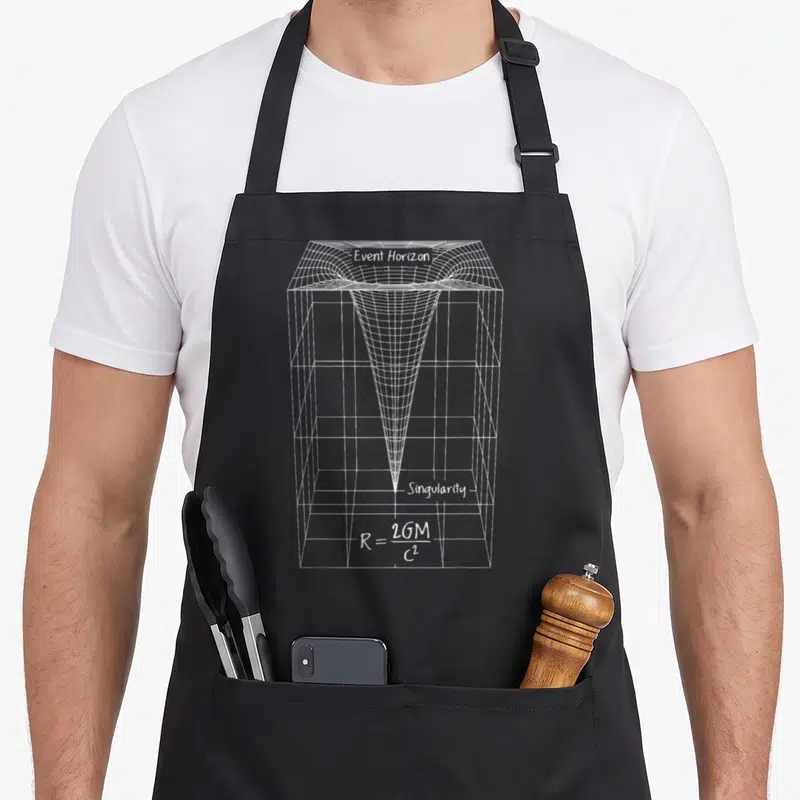
Diagram science apron - White wireframe black hole grid diagram with event horizon singularity label and R=2GM/C^2
US$19.95
Flat US$4.95 US shipping · free over US$65.00 · sales tax is calculated from your shipping address at checkout.
1
US$19.95
Delivery to United States
Arrives —
Orders ship within the United States only. Flat US$4.95 shipping under US$65.00 — free from US$65.00.
Returns
Request a return or exchange within 30 days of purchase, for any reason — we cover return shipping.
Printed to order
Every apron is printed after you order it. Please allow 1-3 business days for processing before it leaves the print shop.
Diagram Science Apron Featuring a White Wireframe Black Hole is printed on a black canvas apron — one size, made to order and shipped within the United States.
diagram science apron displays a white line-art diagram of a black hole on the front panel. The printed text labels the top rim as Event Horizon and the bottom point as Singularity, accompanied by the formula R = 2GM/C^2 at the base. This design signals appreciation for astrophysics without relying on humor. Wearing it identifies the wearer as someone who understands spacetime curvature. Students and researchers in quantum theory or lab technicians will feel this technical illustration was made specifically for their work.
The Artwork Explained
This diagram science apron presents a stark white wireframe structure representing a three-dimensional grid funnel against a neutral background. The grid lines warp inward to visualize the gravity well of a black hole. Labels identify the upper opening as Event Horizon and the lower convergence point as Singularity. The mathematical expression R = 2GM/C^2 sits at the bottom base of the diagram. This line-art style renders complex astrophysics concepts into a clear, educational visual that belongs in academic settings and serious scientific study.
Kitchens It Belongs In
This diagram science apron fits naturally in university labs or home workshops where astrophysics is studied. It serves as professional gear for students majoring in physics or working as lab technicians. The two front pockets provide practical storage for pens and small tools during long experiments. Researchers who wear it signal their expertise in gravitational mechanics while protecting their clothing from daily wear.
What Buyers Ask
Does the apron fit over layers? Yes, the 10 oz cotton canvas material stiffens initially but softens after two or three washes to accommodate bulkier clothing underneath. This fabric weight ensures the garment maintains its shape even when worn over sweaters or lab coats during cold weather shifts.
Will the ink stay sharp after cleaning? The white line-art print remains durable because the high-contrast design withstands standard laundering cycles without fading. Cotton canvas holds up to repeated washing, keeping the geometric grid and mathematical formulas legible through extensive use in busy environments.
What does the formula at the bottom represent? The equation R = 2GM/C^2 calculates the Schwarzschild radius, which defines the size of the event horizon for a non-rotating black hole. This specific physics constant anchors the visual diagram in real astrophysical theory rather than generic space imagery.
Every apron is printed after you order it. Orders are processed Monday through Friday, excluding federal holidays — please allow 1-3 business days for order processing. After processing, shipping typically takes 3-7 business days inside the United States, so the total delivery time from order placement is 4-10 business days.
US orders under US$65.00 pay a flat US$4.95 shipping; orders of US$65.00 or more ship free. Bearhap ships within the United States only — we do not ship to international addresses.
You may request a return or exchange within 30 days of the purchase date, for any reason. The apron must be unopened, unused and in its original packaging, with proof of purchase. We refund the item price in full to the original payment method — the original US$4.95 shipping fee is not refundable — and Bearhap covers all return shipping costs: email contact@bearhap.com for a free return label.
Care
Machine wash cold, inside out, with like colours. Tumble dry low or hang to dry. Do not iron directly over the print — press from the back if you need to. No bleach, no dry cleaning.
The ink is water-based and cures into the fabric, so it will soften with the canvas rather than peel off it.
Questions about Black Hole aprons
- Who is this collection best suited for?
- This set is ideal for astronomers, physics students, and science communicators who want to display their passion for cosmology. It appeals to anyone who enjoys deep discussions about gravity, time dilation, and the structure of the universe during casual gatherings or professional events.
- What makes these designs unique?
- The designs focus on accurate representations of black hole phenomena like the M87 image and gravitational effects. They avoid generic space clichés, instead using specific scientific terminology and visual references that resonate with people who study or teach advanced physics concepts regularly.
- How should I choose between the options?
- Select based on your preferred level of technical detail. Choose the hole astrophysicist version for direct scientific references, or the funny hole option if you prefer broader appeal. Consider whether you want to highlight academic knowledge or simply share a love for cosmic mysteries with a wider audience.
You might also like
More black hole
- hole astrophysic astronomer apron
- physicist hole science apron
- event black hole apron
- geometry black hole apron
- hole science apron
- sun astrophysicist apron
- hole physic astrophysicist apron
- hole physic science apron