

Astrophysicist
Future Astronomy Lover Apron Featuring FUTURE ASTROPHYSICIST
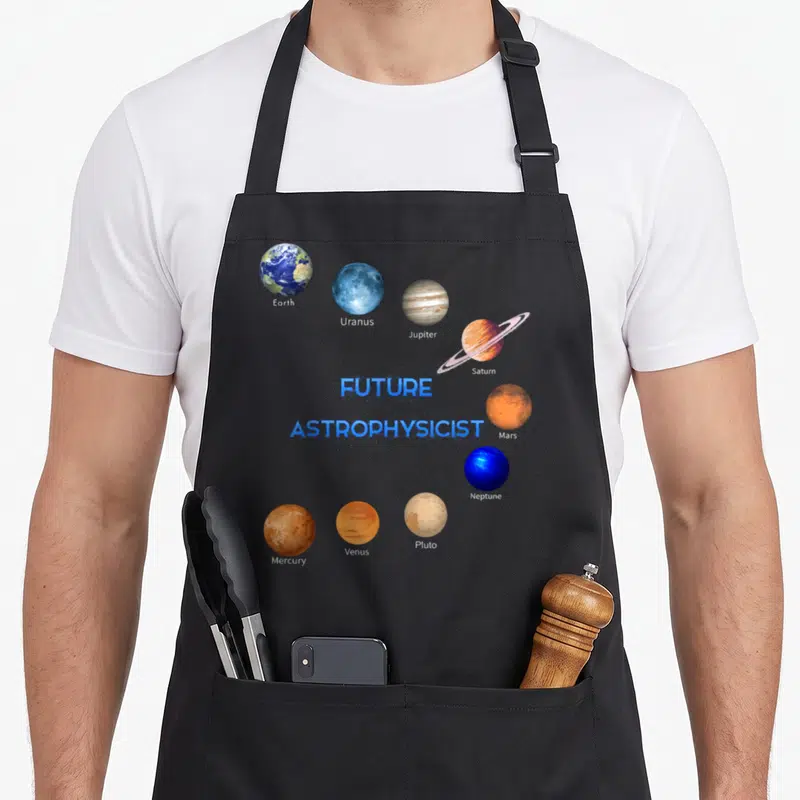
Future astronomy lover apron - Nine labeled planets orbiting FUTURE ASTROPHYSICIST text in blue orange brown white
US$19.95
Flat US$4.95 US shipping · free over US$65.00 · sales tax is calculated from your shipping address at checkout.
1
US$19.95
Delivery to United States
Arrives —
Orders ship within the United States only. Flat US$4.95 shipping under US$65.00 — free from US$65.00.
Returns
Request a return or exchange within 30 days of purchase, for any reason — we cover return shipping.
Printed to order
Every apron is printed after you order it. Please allow 1-3 business days for processing before it leaves the print shop.
Future Astronomy Lover Apron Featuring FUTURE ASTROPHYSICIST is printed on a black canvas apron — one size, made to order and shipped within the United States.
This future astronomy lover apron puts "FUTURE ASTROPHYSICIST" across the front panel, and the words read as a declaration of career intent for young scientists. Arranged in a circular orbit around the central text are Earth, Uranus, Jupiter, Saturn, Mars, Neptune, Pluto, Venus, and Mercury, each labeled below. Wearing it signals dedication to the cosmos before any degree is earned, and parents or teachers who value early STEM education feel this was made for their student.
What You Are Looking At
The planetary arrangement features nine distinct celestial bodies rendered in photo style using blue, orange, brown, and white tones. The text "FUTURE ASTROPHYSICIST" is centered in bold blue lettering surrounded by scattered speckles suggesting stars. Each planet appears with its name printed directly beneath it in small white type. This layout mimics a solar system diagram without being a textbook illustration. The combination of realistic textures and clear labeling makes the design educational rather than decorative.
The Right Person For It
A child studying space science or an adult mentoring young researchers notices the accurate planetary labels first. Gifting this future astronomy lover apron suits birthdays or science fair celebrations where curiosity is rewarded. It stays practical during hands-on learning sessions where spills are expected but focus remains on discovery.
Details Worth Asking About
What are the pocket dimensions? Each front pocket measures 8 x 7 inches and is split in the middle to hold tools or notebooks securely while cooking or conducting experiments.
How does the ink withstand washing? The printed planets and text use durable application that holds up through multiple washes because the colors remain distinct even after repeated exposure to water and detergent.
Why does this design differ from generic space aprons? It includes all nine bodies including Pluto and uses photo-style rendering instead of cartoon icons, making it suitable for serious study contexts rather than play.
Every apron is printed after you order it. Orders are processed Monday through Friday, excluding federal holidays — please allow 1-3 business days for order processing. After processing, shipping typically takes 3-7 business days inside the United States, so the total delivery time from order placement is 4-10 business days.
US orders under US$65.00 pay a flat US$4.95 shipping; orders of US$65.00 or more ship free. Bearhap ships within the United States only — we do not ship to international addresses.
You may request a return or exchange within 30 days of the purchase date, for any reason. The apron must be unopened, unused and in its original packaging, with proof of purchase. We refund the item price in full to the original payment method — the original US$4.95 shipping fee is not refundable — and Bearhap covers all return shipping costs: email contact@bearhap.com for a free return label.
Care
Machine wash cold, inside out, with like colours. Tumble dry low or hang to dry. Do not iron directly over the print — press from the back if you need to. No bleach, no dry cleaning.
The ink is water-based and cures into the fabric, so it will soften with the canvas rather than peel off it.
Questions about Astrophysicist aprons
- Who is the ideal buyer for these designs?
- This collection suits university professors, research scientists, and amateur stargazers who appreciate the intersection of hard science and creative expression. It is made for those who want to display their passion for cosmology in a casual, everyday setting without being overly formal.
- What specific scientific concepts are represented here?
- You will find representations of solar flares, planetary orbits, gamma-ray physics, and foundational astronomical formulas. Each design translates complex astrophysical theories into visual art, making them recognizable to peers in the field while remaining aesthetically pleasing to general observers interested in space.
- How do I choose the right design?
- Select based on your specific area of interest, such as solar physics or general cosmology. If you prefer artistic interpretations, choose the Van Gogh style. For pure data lovers, the formula-based designs offer a direct connection to the equations that define our understanding of the cosmos.
You might also like
More astrophysicist
- astrophysic science apron
- planet astronomy life apron
- astrophysicist science apron
- system astrophysicist apron
- colorful planet science apron
- our science apron
- astronomy space apron
- star science apron


