
Machinist
G28 Machinist Apron Featuring G-Code Typography with Red
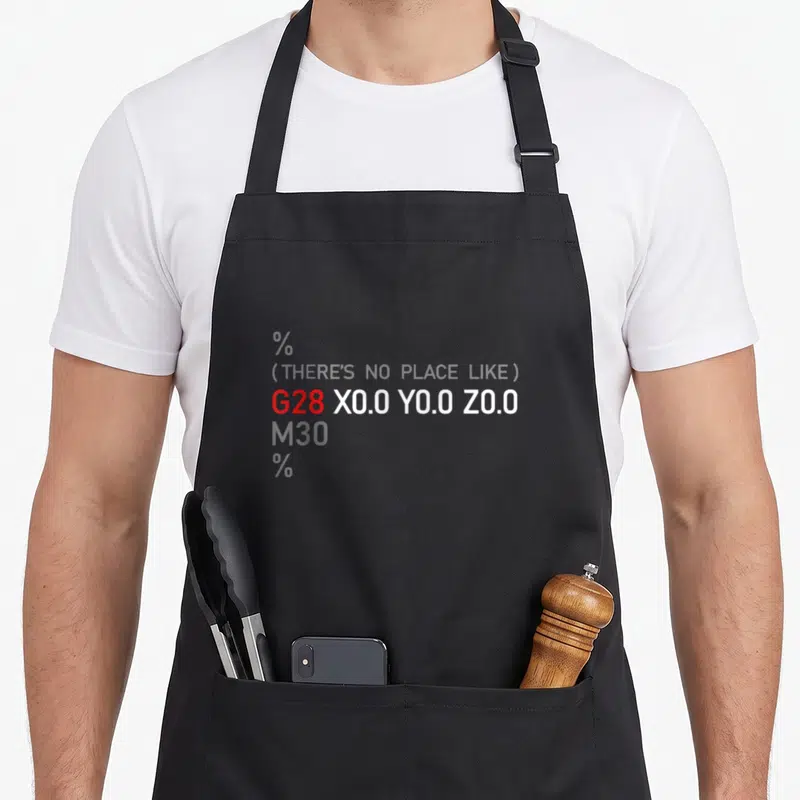
G28 machinist apron - Stacked G-Code text G28 in red X0.0 Y0.0 Z0.0 in white on grey background
US$19.95
Flat US$4.95 US shipping · free over US$65.00 · sales tax is calculated from your shipping address at checkout.
1
US$19.95
Delivery to United States
Arrives —
Orders ship within the United States only. Flat US$4.95 shipping under US$65.00 — free from US$65.00.
Returns
Request a return or exchange within 30 days of purchase, for any reason — we cover return shipping.
Printed to order
Every apron is printed after you order it. Please allow 1-3 business days for processing before it leaves the print shop.
G28 Machinist Apron Featuring G-Code Typography with Red is printed on a black canvas apron — one size, made to order and shipped within the United States.
The g28 machinist apron puts a stack of five lines of CNC code across the front panel, and the phrase (THERE'S NO PLACE LIKE) reads as a pun on a classic song. The bold red G28 combined with white coordinates lands as a return to home command. Wearing it signals pride in the shop floor, and this design was made for CNC operators and machinists who speak G-code fluently.
Every Detail On The Front
Five distinct lines of text stack vertically down the center of the grey canvas panel. The top and bottom lines feature faint grey percent signs that act as visual bookends for the composition. A pair of parentheses containing the words THERE'S NO PLACE LIKE sits just above the primary command in the same subtle grey tone. The focal point is the third line where G28 appears in vivid red followed immediately by X0.0 Y0.0 Z0.0 in stark white. This specific color separation emphasizes the homing function over the auxiliary codes. The entire layout uses a clean, blocky typeface that resembles digital display fonts rather than traditional serif lettering. No images or illustrations interrupt the flow of these alphanumeric characters. The design belongs strictly to the world of machine programming and industrial interfaces. The contrast between the bright central command and the faded surrounding elements creates a hierarchy that guides the eye directly to the most critical data points.
Built For These Hands
Machinists and CNC programmers notice the immediate recognition of standard G-code syntax on the chest. This g28 machinist apron functions as a uniform for those who spend their days at control panels. It is an ideal present for birthdays, Christmas, or appreciation events for dads, husbands, or brothers in the trade. The wearer stands in a workshop surrounded by machinery and understands the specific humor of treating a machine zero point as a destination. The design validates the daily routine of returning to home position as a ritualistic act. The sturdy canvas construction supports the practical needs of someone moving between heavy equipment. Tools stay secure in the split pockets while the graphic remains visible to fellow technicians. The apron bridges the gap between technical utility and insider cultural expression.
Practical Questions
What are the pocket dimensions on this apron? Each pocket measures exactly 8 by 7 inches to accommodate standard hand tools. They are split in the middle to allow items to slide in from either side without removal. This specific dimension ensures that calipers, screwdrivers, or markers fit securely during movement. The size balances capacity with the need to keep the lower torso area relatively unobstructed for bending over machines. You will not find oversized cargo pockets here, but the provided space is sufficient for essential shop tasks. How does the ink hold up to industrial washing cycles? The print survives repeated laundering because it adheres directly to the dense 10 oz cotton canvas fibers. The fabric texture helps lock the pigment in place better than lighter materials might. While specific washing instructions are not detailed here, the durability comes from the heavy weave of the base material. The colors remain distinct because they are not sitting on top of a thin coating. This construction ensures the design stays sharp through the rigors of a typical work week. Why is the G28 line colored differently than the rest? The red coloring of G28 visually separates the homing command from the coordinate data and decorative elements. In G-code programming, G28 is a specific function that returns axes to a reference point, making it the active verb of the sentence. By highlighting it in red, the design mimics the way critical commands stand out in software interfaces. The white coordinates follow as the target destination, while the grey text acts as background atmosphere. This color choice reinforces the technical accuracy of the pun.
Every apron is printed after you order it. Orders are processed Monday through Friday, excluding federal holidays — please allow 1-3 business days for order processing. After processing, shipping typically takes 3-7 business days inside the United States, so the total delivery time from order placement is 4-10 business days.
US orders under US$65.00 pay a flat US$4.95 shipping; orders of US$65.00 or more ship free. Bearhap ships within the United States only — we do not ship to international addresses.
You may request a return or exchange within 30 days of the purchase date, for any reason. The apron must be unopened, unused and in its original packaging, with proof of purchase. We refund the item price in full to the original payment method — the original US$4.95 shipping fee is not refundable — and Bearhap covers all return shipping costs: email contact@bearhap.com for a free return label.
Care
Machine wash cold, inside out, with like colours. Tumble dry low or hang to dry. Do not iron directly over the print — press from the back if you need to. No bleach, no dry cleaning.
The ink is water-based and cures into the fabric, so it will soften with the canvas rather than peel off it.
Questions about Machinist aprons
- Who is the ideal buyer for these machinist-themed aprons?
- These aprons suit professional machinists, CNC operators, and toolroom engineers who appreciate precision work. They are also made for vocational students learning metalworking skills or hobbyists running home workshops. Anyone who identifies with the disciplined culture of machine shops will feel represented by these specialized designs.
- What specific designs are included in this collection?
- This group includes the flag, CNC, engineer, tolerance, issue, run, fix, and definition machinist aprons. Each design incorporates industry-specific imagery such as calipers, G-code snippets, and metallurgical charts. The variety ensures every shop professional finds a graphic that resonates with their specific trade focus or daily responsibilities.
- How should I choose the right design from this set?
- Select based on your primary role within the machine shop environment. Choose the CNC version if you program machines, or the engineer style for design-focused roles. Those who enjoy discussing shop problems might prefer the issue design, while purists may lean toward the tolerance graphic for its emphasis on dimensional accuracy.
You might also like
More machinist
- cnc machinist apron
- cnc g28 machinist apron
- code machinist apron
- run cnc machinist apron
- run machinist apron
- retired machinist apron
- grand area code apron
- coding nerd apron