

Centennial
History Centennial Apron Commemorating 100 Years of Black
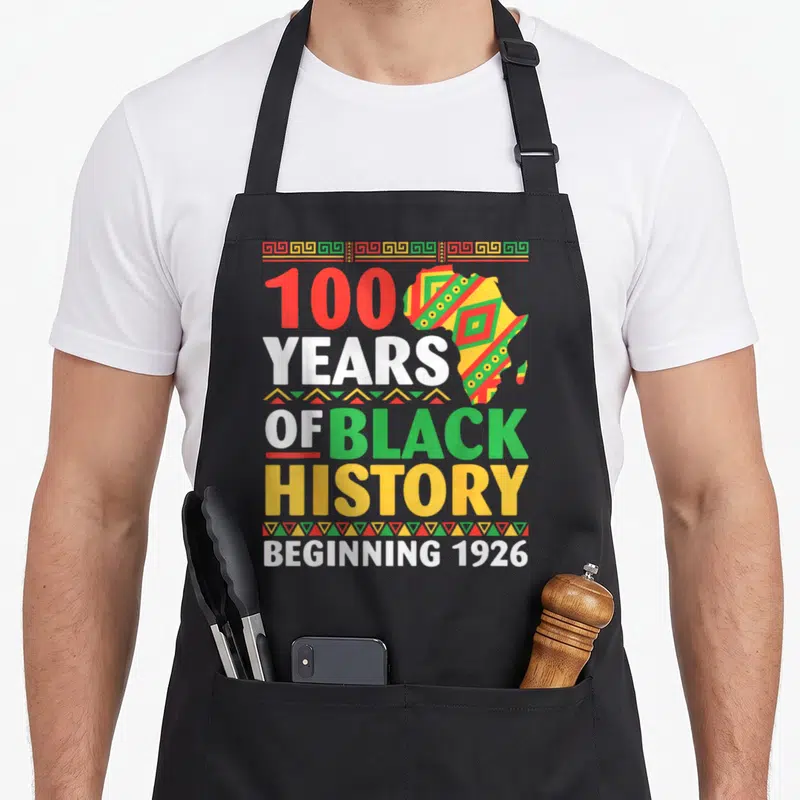
History centennial apron - 100 years of black history beginning 1926 text with patterned africa map and geometric
US$19.95
Flat US$4.95 US shipping · free over US$65.00 · sales tax is calculated from your shipping address at checkout.
1
US$19.95
Delivery to United States
Arrives —
Orders ship within the United States only. Flat US$4.95 shipping under US$65.00 — free from US$65.00.
Returns
Request a return or exchange within 30 days of purchase, for any reason — we cover return shipping.
Printed to order
Every apron is printed after you order it. Please allow 1-3 business days for processing before it leaves the print shop.
History Centennial Apron Commemorating 100 Years of Black is printed on a black canvas apron — one size, made to order and shipped within the United States.
history centennial apron puts 100 YEARS OF BLACK HISTORY BEGINNING 1926 across the front panel, and the words read as a direct commemoration of the 1926 founding of Negro History Week. Wearing it honors ancestors while preparing meals, and scholars and cooks who value cultural preservation feel it was made for them.
Reading The Design
Vertical typography stacks bold letters in red, white, green, yellow, and black down the center of the panel, anchoring the composition with heavy weight. A stylized map of Africa sits to the right of the upper lines, filled with geometric shapes like diamonds and circles in matching vibrant hues. Geometric borders appear above the main text, in the middle separating phrases, and below the year 1926 to frame the entire layout. This design belongs to the tradition of African American heritage art where typography acts as the primary visual model rather than illustration. The combination of the specific date and the continent map creates a unified statement about lineage and time without relying on figurative imagery.
When People Wear It
Black history month observers and educators notice the precise 1926 date immediately upon seeing this history centennial apron worn in a classroom or kitchen. It is an ideal gift for Juneteenth or any occasion celebrating African roots and black pride within the community. Home cooks wear it daily to protect clothing while working, transforming routine food prep into an act of cultural remembrance and visibility.
Common Questions
What are the dimensions of the storage pockets? The two front pockets measure exactly 8 x 7 inches each, offering sufficient space for holding small tools. They are split in the middle to create separate compartments that keep items organized and accessible while you cook or teach without cluttering the workspace. How durable is the printed ink against laundering? The print is designed to withstand repeated washing because the ink bonds securely to the 10 oz cotton canvas fabric. Since the material stiffens initially and softens after two to three washes, the textile adapts to your body while maintaining the integrity of the bold colored lettering and geometric patterns over time. Does the text refer to a specific historical milestone? Yes, the phrase explicitly references the centennial of the start of Negro History Week in 1926, established by Carter G. Woodson. This distinguishes the design from generic anniversary themes by grounding it in the actual birth of organized black history education and cultural recognition in the United States.
Every apron is printed after you order it. Orders are processed Monday through Friday, excluding federal holidays — please allow 1-3 business days for order processing. After processing, shipping typically takes 3-7 business days inside the United States, so the total delivery time from order placement is 4-10 business days.
US orders under US$65.00 pay a flat US$4.95 shipping; orders of US$65.00 or more ship free. Bearhap ships within the United States only — we do not ship to international addresses.
You may request a return or exchange within 30 days of the purchase date, for any reason. The apron must be unopened, unused and in its original packaging, with proof of purchase. We refund the item price in full to the original payment method — the original US$4.95 shipping fee is not refundable — and Bearhap covers all return shipping costs: email contact@bearhap.com for a free return label.
Care
Machine wash cold, inside out, with like colours. Tumble dry low or hang to dry. Do not iron directly over the print — press from the back if you need to. No bleach, no dry cleaning.
The ink is water-based and cures into the fabric, so it will soften with the canvas rather than peel off it.
Questions about Centennial aprons
- Who is the ideal buyer for these historical designs?
- The ideal buyer is someone interested in American history, specifically the women's suffrage movement. Teachers, students, and activists appreciate the educational value of wearing these symbols. The collection resonates with individuals who celebrate the centennial milestones of the Nineteenth Amendment and its lasting impact on society today.
- What specific historical events are depicted in these aprons?
- These aprons depict the journey toward the ratification of the Nineteenth Amendment in 1920. Designs focus on the fight for voting rights, the activism of the 1920s, and the significance of the centennial anniversary. They serve as visual tributes to the pioneers who campaigned tirelessly for equal suffrage across the nation.
- How do I choose between the different thematic options?
- Choose based on your preferred visual style, whether it is bold text or subtle graphics. Consider if you want to emphasize the legal amendment itself or the broader cultural shift of the 1920s. Each design honors the same core achievement but offers distinct artistic interpretations suitable for various personal tastes and professional settings.
You might also like
More centennial
- excellence centennial apron
- centennial colorado apron
- centennial distressed apron
- national grand canyon apron
- history month african print apron
- honoring african apron
- honoring future it apron
- patriotic african american aprons