

African
Juneteenth African Apron with Raised Fist
Juneteenth african apron - Raised fist in red black and green with Juneteenth 1865 text and crossed out July 4th
US$19.95
Flat US$4.95 US shipping · free over US$65.00 · sales tax is calculated from your shipping address at checkout.
1
US$19.95
Delivery to United States
Arrives —
Orders ship within the United States only. Flat US$4.95 shipping under US$65.00 — free from US$65.00.
Returns
Request a return or exchange within 30 days of purchase, for any reason — we cover return shipping.
Printed to order
Every apron is printed after you order it. Please allow 1-3 business days for processing before it leaves the print shop.
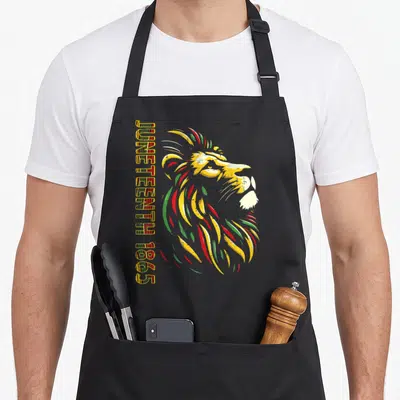
Juneteenth African Apron with Raised Fist is printed on a black canvas apron — one size, made to order and shipped within the United States.
The phrase "juneteenth african apron" introduces a design featuring the text JULY 4TH, JUNETEENTH, 1865, BECAUSE MY ANCESTORS WEREN'T FREE IN 1776. A raised fist colored in red, black, and green sits between two blocks of white lettering. The reference corrects the historical timeline by striking through July 4th to emphasize freedom arrived in 1865. Wearing it signals a commitment to accurate history during kitchen work. People who value heritage and truth find this specific garment made for them.
The Design Itself
This juneteenth african apron centers a raised fist divided into three distinct color blocks of red, black, and green. White text appears in two separate blocks, one positioned above the fist and the other below it. A thin red line strikes horizontally through the top line reading JULY 4TH to visually negate that date. The remaining text states JUNETEENTH 1865 followed by the explanation BECAUSE MY ANCESTORS WEREN'T FREE IN 1776. The minimalist art style relies on these four colors—white, red, black, and green—to create a high-contrast image. The layout uses the central fist as an anchor point connecting the corrected date above with the historical context below. This arrangement turns the garment into a focused visual argument about when freedom actually began.
Occasions It Fits
Cooking enthusiasts attending Juneteenth celebrations notice the specific date 1865 and the crossed-out July 4th first. Gifting this item to someone who understands Black history makes sense for Emancipation Day or Independence Day gatherings. Everyday situations involving meal prep become opportunities to display pride and historical awareness. The wearer can engage in conversation about ancestry while handling ingredients safely. This product bridges the gap between culinary tasks and cultural education effectively.
Things People Ask
What are the measurements of the body and waist ties? The body measures 28 inches wide by 34 inches long to cover the torso adequately. Waist ties extend 42 inches on each side to allow for secure tying in front. These dimensions ensure the central design remains visible and the fit stays comfortable during movement. The length of the ties accommodates various waist sizes without needing additional knots.
How does the ink hold up to washing and heat? The printed graphics remain durable through standard cleaning cycles because they are integrated into the fabric surface. Heat from stovetops or ovens does not degrade the white, red, black, or green colors used in the print. The minimalist design lacks fine gradients that might fade faster, ensuring the bold shapes stay intact. Regular laundering maintains the clarity of the text and the fist symbol over time.
Why is the date 1776 crossed out on this specific apron? The text explicitly states that ancestors were not free in 1776, which necessitates the visual correction. A red line strikes through JULY 4TH to reject that date as relevant to their liberation. The design clarifies that true freedom corresponds to the year 1865 instead of the original founding date. This distinction is the core message of the artwork and explains the specific phrasing used.
Every apron is printed after you order it. Orders are processed Monday through Friday, excluding federal holidays — please allow 1-3 business days for order processing. After processing, shipping typically takes 3-7 business days inside the United States, so the total delivery time from order placement is 4-10 business days.
US orders under US$65.00 pay a flat US$4.95 shipping; orders of US$65.00 or more ship free. Bearhap ships within the United States only — we do not ship to international addresses.
You may request a return or exchange within 30 days of the purchase date, for any reason. The apron must be unopened, unused and in its original packaging, with proof of purchase. We refund the item price in full to the original payment method — the original US$4.95 shipping fee is not refundable — and Bearhap covers all return shipping costs: email contact@bearhap.com for a free return label.
Care
Machine wash cold, inside out, with like colours. Tumble dry low or hang to dry. Do not iron directly over the print — press from the back if you need to. No bleach, no dry cleaning.
The ink is water-based and cures into the fabric, so it will soften with the canvas rather than peel off it.
Questions about African aprons
- Who should buy these aprons?
- People who want to celebrate their African heritage in a visible and smart manner. These pieces are ideal for anyone who enjoys expressing cultural pride through everyday wearables and wants to spark conversations about identity and history.
- What designs are included?
- The collection features unique prints such as the pan african apron, kente african apron, and juneteenth queen african apron. Each design focuses on specific aspects of African culture, history, and symbolism to create a meaningful wearing experience.
- How do I choose one?
- Select a design based on which aspect of heritage resonates most with you. Consider whether you prefer broad continental symbols like the pan african apron or specific historical commemorations like the juneteenth queen african apron for your personal style.
You might also like
More african
- free african apron
- lion african apron
- freeish african apron
- juneteenth history african apron
- june african american aprons
- ancestor african apron
- juneteenth african american aprons
- juneteenth freedom african american aprons