
Astrophysicist
Planet Astrophysicist Apron Featuring Seven Colorful Planets
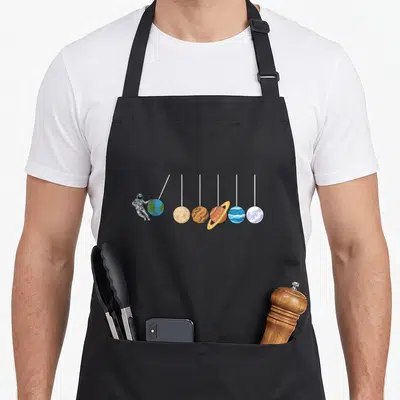
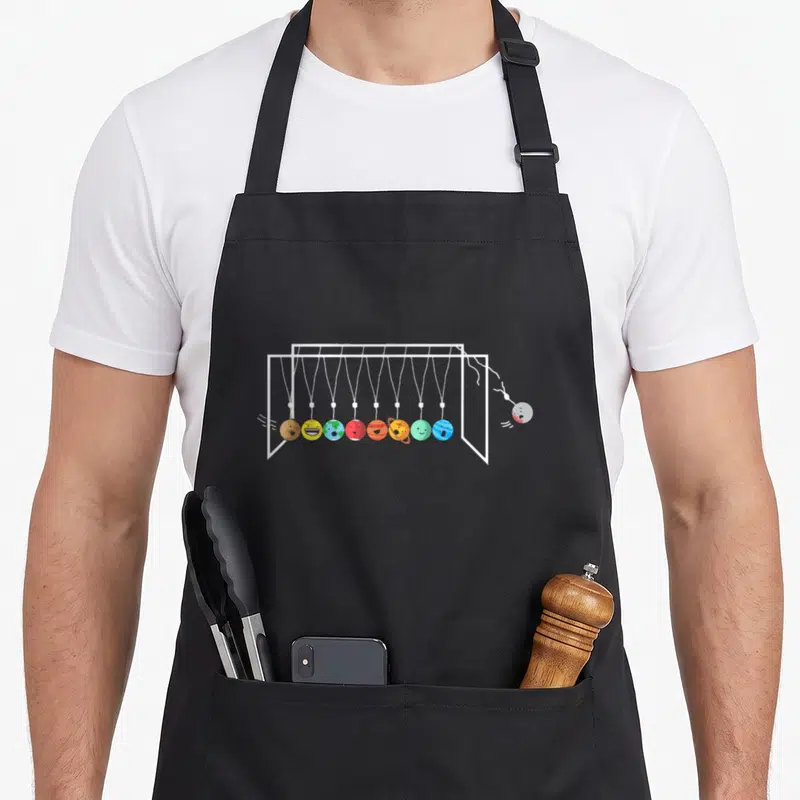
Planet astrophysicist apron - Seven colorful planets in white frame Newton cradle with grey moon knocked aside
US$19.95
Flat US$4.95 US shipping · free over US$65.00 · sales tax is calculated from your shipping address at checkout.
1
US$19.95
Delivery to United States
Arrives —
Orders ship within the United States only. Flat US$4.95 shipping under US$65.00 — free from US$65.00.
Returns
Request a return or exchange within 30 days of purchase, for any reason — we cover return shipping.
Printed to order
Every apron is printed after you order it. Please allow 1-3 business days for processing before it leaves the print shop.
Planet Astrophysicist Apron Featuring Seven Colorful Planets is printed on a black canvas apron — one size, made to order and shipped within the United States.
planet astrophysicist apron displays a cartoon illustration of seven planets arranged as balls in a white frame Newton's cradle, with a grey moon knocked away to the right. This visual pun replaces the standard metal spheres with colorful celestial bodies to celebrate space science. Wearing it protects your clothes while signaling you appreciate physics humor. Space enthusiasts and educators who enjoy clever science references will feel this design was made for them.
A Closer Look At The Artwork
The central image places seven distinct planets suspended by thin lines inside a geometric white outline representing a Newton's cradle frame. Each planet ball is rendered in specific shades of white, grey, blue, red, and yellow to differentiate the celestial bodies. To the far right, a grey moon hangs separately with motion lines indicating it has just struck the main row. The cartoon art style simplifies the planets into round shapes with minimal surface details. This composition transforms a classic physics demonstration into a humorous solar system display that requires no text to explain the reference.
Where It Earns Its Keep
Physics students and amateur astronomers notice the clever substitution of planets for metal balls immediately. A planet astrophysicist apron makes a distinctive gift for anyone who studies celestial mechanics or enjoys science-based wordplay. It earns its keep in university labs, home kitchens, or classroom settings where the wearer wants to display their passion for astronomy without speaking.
Good To Know
What are the measurements of the waist ties and body size? The waist ties measure 42 inches on each side to ensure a secure fit. This length allows the straps to be tied comfortably in front regardless of torso size. The body size measures 28 inches wide by 34 inches long to provide substantial coverage for cooking or working. How does the ink hold up during washing cycles? The printed design is durable enough to withstand standard washing routines. The cartoon colors remain vibrant because the print adheres permanently to the fabric surface. You can clean the apron regularly without worrying about the solar system illustration fading or peeling. Why is the grey moon depicted separately from the main row? The grey moon is shown knocked away to illustrate the transfer of momentum in a Newton's cradle. This specific detail creates the visual joke by showing the impact point outside the stationary group. No other product features this exact depiction of a displaced lunar body.
Every apron is printed after you order it. Orders are processed Monday through Friday, excluding federal holidays — please allow 1-3 business days for order processing. After processing, shipping typically takes 3-7 business days inside the United States, so the total delivery time from order placement is 4-10 business days.
US orders under US$65.00 pay a flat US$4.95 shipping; orders of US$65.00 or more ship free. Bearhap ships within the United States only — we do not ship to international addresses.
You may request a return or exchange within 30 days of the purchase date, for any reason. The apron must be unopened, unused and in its original packaging, with proof of purchase. We refund the item price in full to the original payment method — the original US$4.95 shipping fee is not refundable — and Bearhap covers all return shipping costs: email contact@bearhap.com for a free return label.
Care
Machine wash cold, inside out, with like colours. Tumble dry low or hang to dry. Do not iron directly over the print — press from the back if you need to. No bleach, no dry cleaning.
The ink is water-based and cures into the fabric, so it will soften with the canvas rather than peel off it.
Questions about Astrophysicist aprons
- Who is the ideal buyer for these designs?
- This collection suits university professors, research scientists, and amateur stargazers who appreciate the intersection of hard science and creative expression. It is made for those who want to display their passion for cosmology in a casual, everyday setting without being overly formal.
- What specific scientific concepts are represented here?
- You will find representations of solar flares, planetary orbits, gamma-ray physics, and foundational astronomical formulas. Each design translates complex astrophysical theories into visual art, making them recognizable to peers in the field while remaining aesthetically pleasing to general observers interested in space.
- How do I choose the right design?
- Select based on your specific area of interest, such as solar physics or general cosmology. If you prefer artistic interpretations, choose the Van Gogh style. For pure data lovers, the formula-based designs offer a direct connection to the equations that define our understanding of the cosmos.
You might also like
More astrophysicist
- cradle astrophysicist apron
- solar astrophysicist apron
- system astrophysicist apron
- planet astronomy life apron
- planet balloon apron
- planet colorful aprons
- colorful planet science apron
- planetary space planets apron